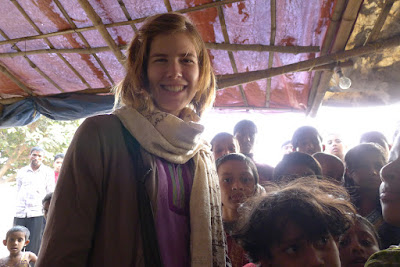
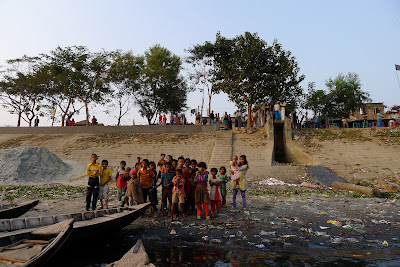
Wednesday, February 23, 2011

Come Visit Bangladesh!

If I am not enough to bring you to Bangladesh in 2011, I have discovered two more unbiased reasons to visit. First, this country is filled with immense natural beauty and an amazing unique culture. If my pictures have not fully convinced you, check out this video:


Second, Bangladesh is one of the cheapest tourist destinations in the world! With 1 US$ (70 Taka to the dollar), you can buy 14 cups of tea, a CNG ride across town, 3 and a half coconuts or a set of bangles. In fact, earlier this year, a Lonely Planet Article named Bangladesh 2011's best value destination. The article reads:

“ This subcontinental treat might just be the cheapest place on earth to travel. Bangladesh offers marvellous meals for under $1, a mid-range hotel room for less than 10 times that. This means that anyone who isn’t a masochist goes up a price bracket or two. You’ll pay a little more to get around the Sunderbans National Park on a tiger-spotting tour – US$150 or thereabouts – but it’s still peanuts, even compared to what you pay next door in India.

Bangladesh is almost disgracefully under-visited. Here, paddleboat is one of the main forms of transport and you can trek, canoe and even surf to your heart’s content with some of the world’s friendliest people for company. The Rocket is Bangladesh’s most famous ferry, running daily between the capital of Dhaka and Khulna. First-class river cruising for 27 hours will cost US$15.”

So, come discover Bangladesh's beauty while I am here and before the country is fully discovered (or under water)!

Tuesday, February 22, 2011

International Mother Language Day

In 1999, UNESCO formally announced February 21st as International Mother Language Day. It is observed every year worldwide to promote awareness of linguistic and cultural diversity. In Bangladesh, today celebrates Bangla language and culture, while at the same time mourns those who sacrificed their lives to keep Bangla the national language.

On the 21st of March, 1948 - when Bangladesh was part of Pakistan, known as East Pakistan - the Pakistani government declared that Urdu would be the official language for both West and East Pakistan. The people of East Pakistan, whose primary language is Bangla, were deeply upset by this ruling, and as a result, the Bangla language movement was born. On the 21st of February, 1952, students of Dhaka University and other activists protested the ruling. In response, the Pakistani police open fired, killing several protesters.

The language movement spread throughout East Pakistan and the entire province came to a standstill. Afterwards, the Pakistani government relented and allowed East Pakistan to keep Bangla as their national language.

Sunday, February 13, 2011

You can steal flowers and books

The first Bangla proverb I learned is "You can steal flowers and books." It was explained that it's okay to steal flowers because they are natural and from the earth, and you can steal books because books give you wisdom.  I really like this proverb, and I think it has even more meaning because I am in a city where nature is hard to find and education is not available for all.

In the last week or so I have stolen both with my camera. The other day, my roommates and I woke up early and headed down to Shabagh flower market. Shabagh flower market is the largest bulk flower market in Bangladesh and from early in the morning until 11am you can find mountains of gada flowers (marigolds), bouquets of roses, baskets of petals, and strands of exotic flowers for hanging and decorating. The market materializes every morning under a footbridge right on the street and by seven it was a slurry of people and flowers. The sun was rising and the air had a wonderful (and unusual for Dhaka) sweet fragrance, and for just about an hour we talked, played and photographed the flowers, each other and the vendors, and almost forgot we were in Dhaka.

Mountains of gada flowers.

Monday, January 31, 2011

Dhaka Zoo and Korail

Some how it has been another week. Time is really going by quickly and I think I am starting to get into the groove of living in Dhaka, or at least as close to a groove as is possible given that it is Dhaka. First off, thanks to everyone for the comments and emails for my blog. I really appreciate all of the feedback and have been trying to incorporate. Also, please email me or comment if you have any questions about Dhaka, Bangladesh, Me, Bangla school or if you have anything you would like me to blog about.

As for my weekend, it started off like any other weekend, not too different from those spent in DC. My language partner and I decided to practice my animal vocab and go check out the zoo (I had heard they had a Bengal tiger which I was interested in seeing). The zoo is all the way in the northwest part of town and a little bit of a trek from where we live so we hopped on a city bus that would get us most of the way there. Everything was going pretty smoothly and we actually got lucky by getting on a bus that was a sitting bus only, meaning the bus would only take enough people as there are seats for.

Sunday, January 23, 2011

Living vs. travelling

It is interesting moving to Dhaka to live here, verses coming for a visit. Usually, I go to foreign countries for vacation and try to cram as much as possible into what little time I have (because I am always running out of time!). This has not been the case so far for Dhaka. Instead of running from one site to the next, I have been enjoying time hanging out with friends (yes, I have friends!) and slowly getting to know my new city.

This past Wednesday was my first real site-seeing day. BLI (Bangla Language Insitute) organized a field trip to Purano Dhaka or Old Dhaka. Purano Dhaka is made up of narrow winding streets, interesting architecture and some good tourist attractions. So at 9am, the only other BLI student this semester (also a Fulbrighter) and I loaded into the van with our entourage, which included a driver, an administrative assistant, and two teachers. Needless to say, we had a wealth of knowledge to tap into, which was definitely nice when we got into a major traffic jam shortly after leaving. It took us about 2 hrs to travel less than 8 miles to our destination, but luckily traffic is still entertaining to me. 
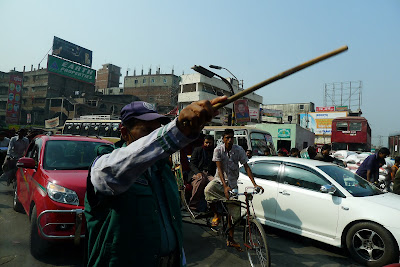
Traffic guard. Old Dhaka.
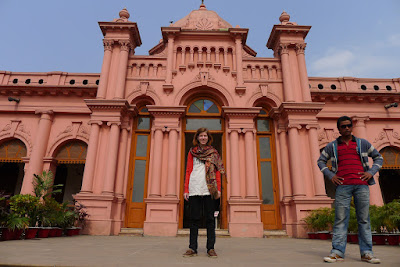
The two major sites we saw were Ahsan Manzil and Lalbagh fort. Ahsan Manzil, also known as the pink palace, was originally a government and trading center but was later sold to the Dhaka Nawab family in the mid-19th century and converted into their residence. When the last Nawab died, Ahsan Manzil fell into direspear, but in the mid 80’s, it was restored and turned into a museum. 
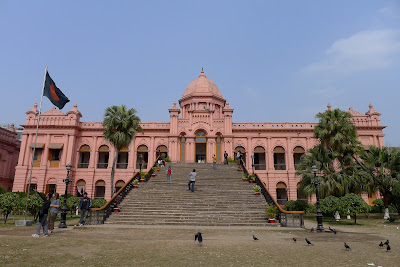
Ahsan Manzil, Old Dhaka.

Me at Ahsan Manzil, Old Dhaka.
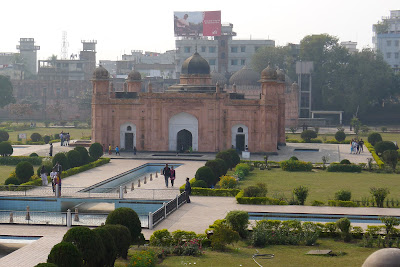
Lalbagh fort contains three buildings, a mosque, the govenor’s residence and a tomb, all surrounded by the fort. Construction of the fort began in 1878, but was never finished.
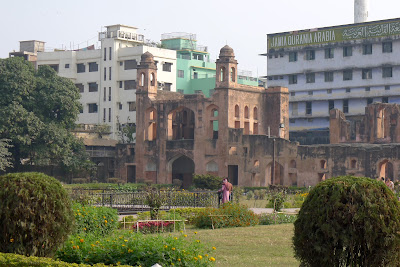
Lalbagh, Old Dhaka.

Mosque at Lalbagh, Old Dhaka.
 That ends my formal touring of Dhaka for now. This weekend, however, I did quite a bit more exploring. I found Old Dhaka really interesting and wanted to go back down there to see a bit more, so three friends (including my language partner) and I headed back down on Friday. Friday is actually a great day traveling around Dhaka because traffic is really light. This is because Friday is sort of like our Sunday. Generally, people stay home on Friday with their family and only in the middle of the day do you have to be careful of traffic because that is when men will head to the mosque for prayer.


So, without much trouble the four of us got down to old Dhaka. This time, though, we decided to go to Sadarghat, a large boat terminal, and take a boat down the Buriganga river. Here are some photos of what we saw from the river:
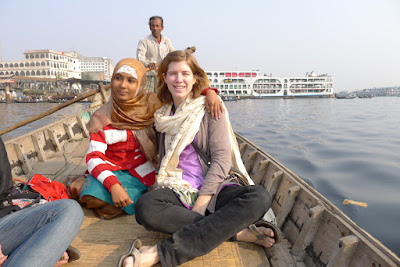
The Sadarghat boat terminal.
Ahsan Manzil from the Buriganga river.
Man washing himself on one the dredging boats used to collect sand for construction.
My language partner and I on the boat.
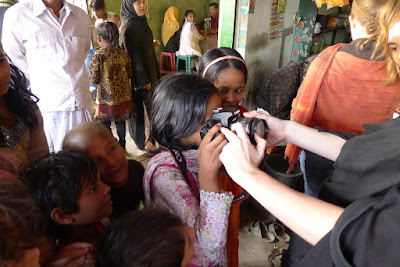
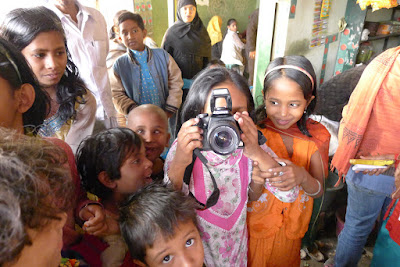
Our destination was a char (pronounced chore), which is a specific type of island. Chars are very vulnerable to flooding, causing the islands to shift and change a lot. Usually, extremely impoverished people live on chars and because the chars are always changing, inhabitants have to resettle fairly often. Because they are not connected to the mainland, chars get very few foreign visitors. So, as we walked around, a crowd slowly grew around us. The people were very friendly and curious as to why we were there and where we came from. Things got really fun, though, when we decided to stop for cha at a little shop. Lots of kids came over to us and asked us why our hair was blonde (three of us have varying shades of blonde hair) and were extremely excited to have their picture taken (as long as we showed them their photo after). The kids were so great and interested in our cameras, that we asked them if they wanted to try taking their own pictures. At first they were a little shy and said no, but after we asked them if they were sure, they turned into excellent photographers.
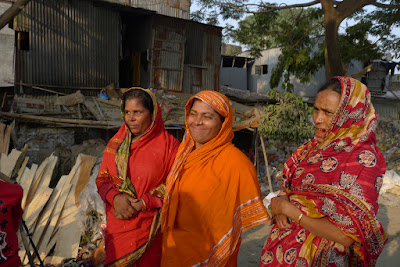
Curious women on the Char.

Sitting down for cha and drawing lots of attention.

Teaching the kids how to take a picture.

A natural.

A photo of me taken by one of the kids.

Goodbye!
After saying our goodbyes, we headed back to old Dhaka and made our way up to Baridhara. The last thing I will share for this post was the incredible block printing shops I found (well actually was shown) in New Market. Yes, I went back down to New Market on Saturday morning. Not that I actually needed to buy anything, but more so because it is so big and there is so much going on there that you could go 100 times and still not have seen everything. 

This time, I saw the block printers. On the third or fourth floor, in an open air building, there is a whole side devoted to block printing. There are tons of blocks, paints, colors, sparkles and fabrics and the printers create the most gorgeous designs I have seen so far in Dhaka. There is just one straight walkway flanked with shop after shop of block printers creating gorgeous artwork. The air smells of paint and the block printers show off their work with hanging salwar kameez, saris, and shawls for passerbys to envy. This was truly an awesome place to see and is another reason why I am happy to be living in Dhaka.
Block Printing, New Market, Dhaka.
The never ending aisle of block printers in New Market.
Block Printing, New Market, Dhaka.

Saturday, January 15, 2011

First Week

I have now officially been in Dhaka for one week. What a week it has been. In fact, I feel like I have done and learned so much in this last week that I should have updated my blog earlier. I will blame my lack of communication on the intermittent internet at my apartment, even though in truth it was just me taking it all in and not being used to writing a blog.

I am slowly adjusting to life in Dhaka. The city itself is absolutely nuts. Walking down the streets the first few days my body was on sensory overload. There are so many people, cars, rickshaws, buildings, shops, street vendors, beggars, dangling power lines and the occasional hole in the sidewalk to avoid that I found myself fatigued after being out for more than a couple hours. I am assuming this is also the reason why I lost my cell phone literally the first time I was out on my own. I am still not quite sure if the phone just slipped out of my pocket or if a hand slipped into it, but somehow I managed to lose my phone in record time. The good news is, I was able to buy a new one for 1,200 Taka, or about $18. 
Noda Bazaar, right outside Baridhara, Dhaka

Friday, January 7, 2011

Made it to Dhaka

After applying for a Fulbright grant to Bangladesh a year and a half ago, I have finally made it to Dhaka. The last month has been a bit of a blur trying to fit in doctor appointments, visa appointments, leaving CBO, learning the Bangla alphabet and of course, most importantly, spending time with friends and family.

I arrived in Dhaka at 8PM last night, and already have a few observations. The first actually occurred prior to landing in Dhaka, and that was how dark the capital city looked from the plane. I am not saying that there were no lights, but considering the size of the city, it felt like I was landing in Waterville, Maine (where I attended Colby). This felt somewhat astonishing considering that Dhaka is a city of nearly 7 million. The one positive outcome of this realization: my research project is relevant and needed.